



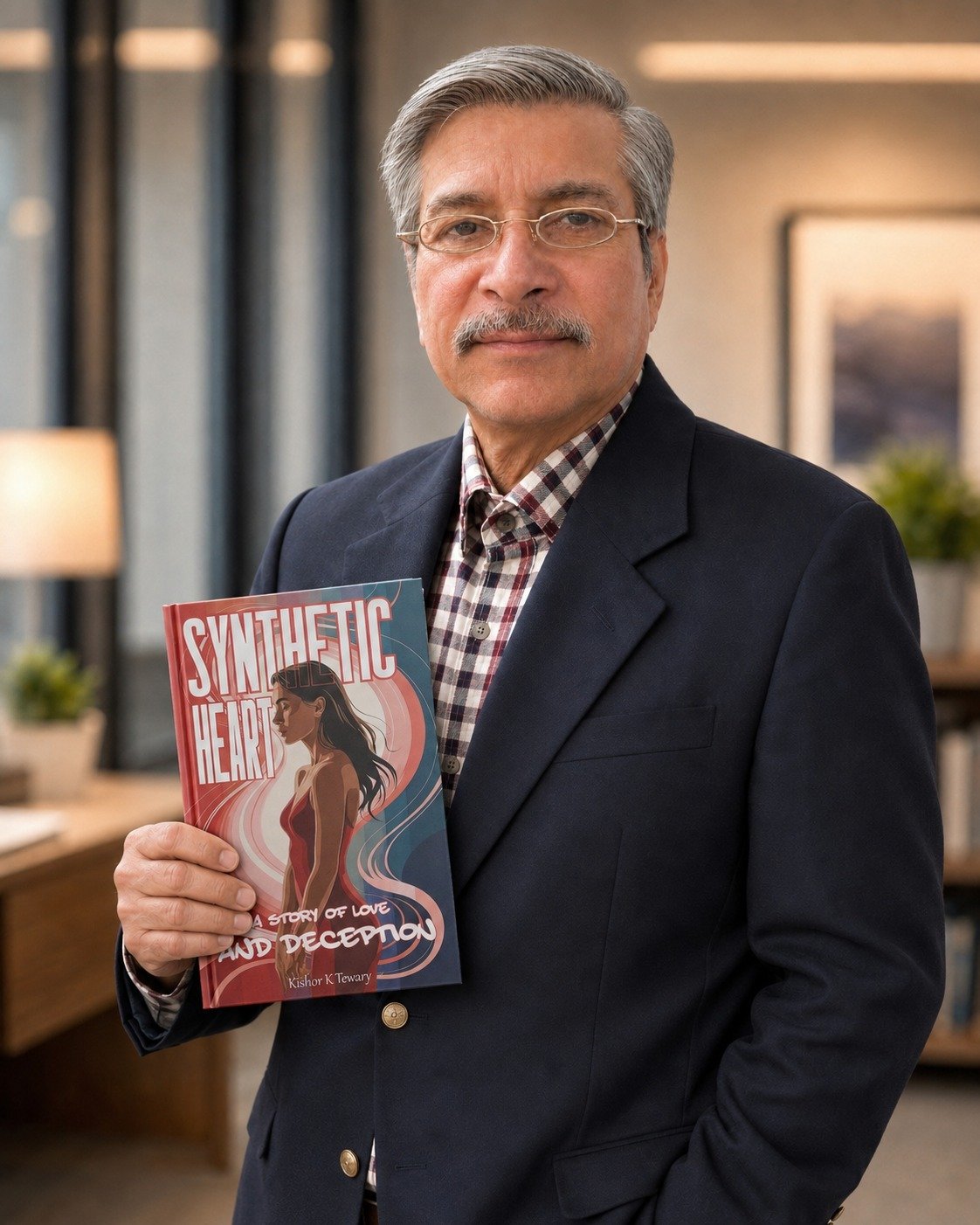
Dr. Kishor K. Tewary is a paediatrician, life and relationship coach, musician, and composer – an unusual blend of science, art, and human understanding.
His debut novel, “Synthetic Heart: a story of Love & deception” is available now on Amazon. https://www.amazon.co.uk/dp/B0H946K1K5.
Visit drkishorktewary.com to explore his work, music, and upcoming projects.
I’ve spent years in exam rooms and coaching sessions watching successful people fall apart. Not dramatically. Not all at once. Slowly. Quietly. The kind of falling apart that happens after the boardroom applause fades and the phone stops buzzing.
They have corner offices. Respect. Bank balances that would make most people weep. Yet, when they sit across from me, they confess the same thing: they feel empty. They have everything the world says matters and nothing that actually does.
We’ve built a culture that worships achievement. We tell ourselves that if we just get that promotion, build that company, earn that recognition, the rest will follow. The peace. The belonging. The love that doesn’t ask for anything in return.
But the data tells a different story.
In 2023, U.S. Surgeon General Dr. Vivek Murthy declared loneliness a public health epidemic, warning that isolation carries health risks equivalent to smoking 15 cigarettes a day. A 2022 Harvard study found that 61% of young adults report feeling “serious loneliness.” Nearly half of Americans say they sometimes or always feel alone.
We are more connected than ever, and more isolated than ever. This isn’t about money or status. It’s about what happens when we mistake independence for strength and control for safety. It’s about the walls we build in the name of success and the people we keep out while we’re busy winning.
As a pediatrician, I’ve watched this play out across generations. Children who grow up with every material advantage but no one at the dinner table. Parents who provide everything except presence. Professionals who achieve everything except intimacy.
And as a life coach, I’ve sat with the aftermath.
I’ve watched people sabotage their deepest relationships because they couldn’t stop testing the people who loved them. They push. They withdraw. They create distance, just to see if anyone will close it. When no one does, they tell themselves they never needed anyone anyway.
They did. They always did.
The Science of Loneliness
The irony is brutal: the very traits that drive success competitiveness, emotional control, self-reliance are the same traits that corrode connection.
Research from Harvard’s 85-year Study of Adult Development found that close relationships are the single strongest predictor of life satisfaction. Not wealth. Not achievement. Not fame. The quality of our connections.
Yet we’ve built a world that systematically undermines connection.
We work longer hours. We move for careers. We optimize for output at the expense of presence. We treat vulnerability as weakness and emotional disclosure as professional liability.
We’ve created a global economy that rewards isolation and calls it ambition.
The Cost We Refuse to Count
A 2020 study in Perspectives on Psychological Science found that loneliness costs the U.S. economy an estimated $154 billion annually in lost productivity. But the human cost is far higher.
Depression. Burnout. Disrupted sleep. Weakened immune function. Accelerated cognitive decline. Loneliness doesn’t just hurt emotionally it hurts physically. It shortens lives. It breaks hearts in ways we’re only beginning to understand.
The Real Lesson
My novel, “Synthetic Heart: a story of Love & deception” , explores this tension through Sarah – a self-made CEO who builds an empire, only to realize she’s built it alone. Her journey mirrors what I’ve witnessed countless times: the slow erosion of connection in the pursuit of control.
Sarah doesn’t lose her empire. She loses something far more precious, the person who saw her without armour. The hardest thing about success isn’t failure. It’s realizing you’ve achieved everything you wanted and you’re standing in it completely alone.
What We Need to Change
We need to start telling a different story.
Success is not a shield. It’s not a substitute for connection. It’s not a cure for loneliness and often, it’s the cause.
We need to revalue vulnerability. We need to recognize that needing others isn’t a weakness, it’s humanity. We need to build workplaces that value presence as much as productivity, and lives that prioritize relationships as much as résumés.
The next time you’re about to work through dinner, cancel on a friend, or stay late for a project, ask yourself: Is this worth the person I’m becoming?
Because when the applause fades and the city goes quiet, the only thing that will matter is whether there’s someone beside you. Someone who knows you – truly knows you, and loves you not for what you built, but for who you are when nothing is demanded of you.
That kind of love doesn’t come from control. It comes from surrender.
And surrendering? That’s the bravest thing you’ll ever do.
Please change as- ”Synthetic Heart: a story of Love & deception”. There is another book on amazon called Synthetic heart.
Replace with ”Synthetic Heart: A story of love & deception”.
Please change as- ”Synthetic Heart: a story of Love & deception”. There is another book on amazon called Synthetic heart.
replaced with isn’t a . Also there should be a comma in between the sentences.